

 Tweet
Tweet
Originally posted by kia027
View Post
-
not defending it but the slavery of the bible is not the same as the trans-atlantic slavery system...an employee of today could be considered a "slave" -

comparing Zoroastrianism with the Abrahamic religionsComment
-
Comment
-
wii kno judaism owes itt origin to da egyptian system aff beeleef so mii qwestian to yuh iss woo zoroastrianism owe itt orgiin to?Comment
-

Comment
-

Christopher Hitchens - Playing 'What if' on Wretched Radio [2009]
Comment
-
it is argued that just as there is a common Afroasiatic language family, so too there is a common Afroasiatic family of religions. There is an inner logic to be found in myths, folk-tales, rituals, customs and beliefs as far apart as Yemen and Nigeria which go back to an ancient past shared by the Bible and the pharaohs.
Using the method of comparative mythology, the author sifts through the work of scholars - including anthropologists, religious historians, archaeologists and classical Greek writers and contemporary comments on them by professional Egyptologists - to build his picture of the Afroasiatic heritage, and how much of it is still with us in modern Western thought.

Comment
-

More than 100 years ago, historians began applying critical methods of documentary analysis to the Judaeo-Christian Bible. To scholars who had hoped to prove the Bible's authenticity, the results were traumatic.
One by one, the various books of the Bible were discovered to contain errors of fact, inaccurate guesses, rationalizations, prophecies ex post facto (usually combined with prophecies of the future that proved inaccurate), and unmistakable, deliberate lies. Such was the power of the churches that, despite the publication of thousands of scholarly books and articles refuting every part of the Judaeo-Christian Bible, to this day the existence of unchallengeable proof that the Bible is a work of fiction is unknown to ninety percent of the population of Christian-dominated societies.
For a century this information has been available only to students willing to wade through dozens of books, each of which deals with only one aspect of Judaeo-Christian mythology. It is hoped that, by bringing together information on the origin and development of every part of the Yahweh- and Jesus-myths, Mythology's Last Gods will make the facts available to a large enough segment of the population to end the equation of god-mythology with history permanently. This is the first book to critically analyze, and take issue with, every section of the Judaeo-Christian Bible from a wholly skeptical, utterly scholarly perspective.
Mythology's Last Gods is a comprehensive history of the development of Judaeo-Christian god-mythology. Harwood traces the beginning of the "god" concept, the evolution of Judaism to the first century, and the evolution of Christianity from its monotheistic beginnings to its emergence as a three-god creed in A.D. 325. Harwood's work reveals many things including that Jesus the Nazarite preached only Essene Judaism, and that every teaching attributed to him can be traced to a pre-Christian source.
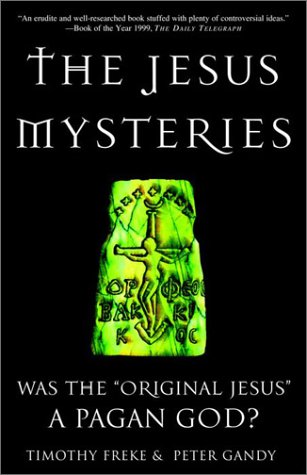
Freke (a philospher and author of books on spirituality) and Gandy (who is studying classical civilization) believe that first century Jewish mystics adapted the potent symbolism of the Osiris-Dionysus myths into a myth of their own, the hero of which was the Jewish dying and resurrecting godman Jesus. Therefore, the story of Jesus is a consciously crafted vehicle for encoded spiritual teachings created by Jewish Gnostics. We are unaware of this, they claim, because the Roman Catholic Church destroyed evidence of the connection between Christianity and the pagan mysteries. They make their case by offering an examination of mystery religions, especially Greek, pointing out the many parallels between them and what they see as the Gospels! message about Jesus. Freke and Gandy are familiar with a significant amount of recent biblical scholarship, though they rely mostly on Elaine Pagels!s work on the Gnostics. This book will obviously be controversial, but the authors are quite informed, as demonstrated by their extensive notes and bibliography. A list of related web sites, a Who!s Who, and an index add to the book!s usefulness. Recommended as an important book in the debate on the historical Jesus."David Bourquin, California State Univ., San BernardinoComment
-

"Prayers offered up in Christian worship in the earliest days of the faith were addressed to 'Our Lord the Sun,' evidencing that 'primitive' Christians were quite in the spirit of Pagan forms and ideologies."
--Alvin Boyd Kuhn, Easter: The Birthday of the Gods
"The Christian religion and Masonry have one and the same common origin: Both are derived from the worship of the Sun. The difference between their origin is, that the Christian religion is a parody on the worship of the Sun, in which they put a man whom they call Christ, in the place of the Sun, and pay him the same adoration which was originally paid to the Sun." --Thomas Paine, Age of Reason
"The Sun has attracted the attention of mankind for adoration all over the world from the very beginning of human history. It has attained the position of pre-eminence among the deities of nature in ancient times. The prominence and glory of the solar orb, its beauty and splendour, its importance in the creation and maintenance of life, its regularity in diffusing light and enlightening the whole earth, its primal role in the cosmic evolution and consequent mystery surrounding it, had secured for the Sun a history of interest and importance equalled by none to which every age and every race has contributed its pages." --V.C. Srivastava, Sun-Worship in Ancient India
Controversial and explosive, The Christ Conspiracy marshals an enormous amount of startling evidence that the religion of Christianity and Jesus Christ were created by members of various secret societies, mystery schools and religions in order to unify the Roman Empire under one state religion! This powerful book maintains that these groups drew upon a multitude of myths and rituals that already existed long before the Christian era and reworked them into the story the Christian religion presents today-known to most Westerners as the Bible.
Author Acharya makes the case that there was no actual person named Jesus, but that several characters were rolled into one mythic being inspired by the deities Mithras, Heracles/Hercules, Dionysus and many others of the Roman Empire. She demonstrates that the story of Jesus, as portrayed in the Gospels, is nearly identical in detail to those of the earlier savior-gods Krishna and Horus, and concludes that Jesus was certainly neither original nor unique, nor was he the divine revelation. Rather, he represents the very ancient body of knowledge derived from celestial observation and natural forces. A book that will initiate heated debate and inner struggle, it is intelligently written and referenced. The only book of its kind, it is destined for controversy.
Chapters in The Christ Conspiracy include:
- The Quest for Jesus Christ
- The Holy Forgery Mill
- Biblical Sources
- Non-Biblical Sources
- Further Evidence of a Fraud
- Physical Evidence
- The Myth of Hebrew Monotheism
- The Characters
- Astrology and the Bible
- The Son of God is the Sun of God
- The Disciples are the Signs of the Zodiac
- The Gospel Story
- Other Elements and Symbols of the Christian Myth
- The Patriarchs and Saints are the Gods of Other Cultures
- The Meaning of Revelation
- The Bible, Sex and Drugs
- Essenes, Zealots and Zadokites
- Alexandria: Crucible of Christianity
- Enter Rome
- The Making of a Myth, etc.
This book contains a table of contents, bibliography and index, and includes over 1,100 citations and 30+ illustrations. Primary sources discussed include the Bible, Dead Sea Scrolls, Talmud, Book of Enoch, Gospel of the Hebrews, Gospel of Thomas, Gospel of the Infancy, Epistle of Barnabas and Shepherd of Hermas, as well as Josephus, Pliny, Tacitus, Suetonius, Justin Martyr, Marcion, Irenaeus, Tertullian, Augustine, Eusebius, Porphyry, Celsus, et al.
.................................................. .................................................. ......................................
Picking up where the bestselling and controversial The Christ Conspiracy leaves off, Suns of God leads the reader through an electrifying exploration of the origin and meaning of the world's religions and popular gods. Over the past several centuries, the Big Three spiritual leaders have been the Lords Christ, Krishna and Buddha, whose stories and teachings are curiously and confoundingly similar to each other. The tale of a miraculously born redeemer who overcomes heroic challenges, teaches ethics and morality, performs marvels and wonders, acquires disciples and is famed far and wide, to be persecuted, killed and reborn, is not unique but a global phenomenon recurring in a wide variety of cultures long before the Christian era.
These numerous godmen were not similar "historical" personages who "walked the earth" but anthropomorphizations of the central focus of the famous "mysteries." A major element of the cryptic, international brotherhood, these mysteries extend back thousands of years and are found worldwide, reflecting an ancient tradition steeped in awe and intrigue. The reasons for this religious development, which has inspired the creation of entire cultures, are unveiled in this in-depth analysis containing fascinating and original research based on evidence both modern and ancient, captivating information kept secret and hidden for ages.
Suns of God is possibly the most complete review of the history of religion from its inception ever composed in a single volume.Comment
-
Caesar > Jesus
Pompey > John (the Baptist)
Antonius > Simon
Lepidus > Peter
(Decimus) Junius (Brutus) > Judas
(Marcus Junius) Brutus > Barabbas
Octavianus (Augustus) > John (the disciple)
Nicomedes of Bithynia > Nicodemus of Bethania
Cleopatra > (Mary) Magdalene
Julia (widow of Marius) > Mary
The Senate > The Sanhedrin
Gaul > Galilee
Rubicon > Jordan
Corfinium > Cafarnaum
Rome > Jerusalem
etc.
People and places have the same function in both stories:
Pompey is the political godfather of Caesar and competes with him in the same way John the Baptist does with Jesus.
Antony and Lepidus became Caesar’s successors, the first as flamen, high priest of the Divus Julius cult, the second as pontifex maximus, just asSimon and Peter do with Jesus (they both melt into one figure – Simon Peter).
Decimus Junius Brutus betrays Caesar as Judas betrays Jesus.
The other Brutus is Caesar’s murderer and Barabbas is a murderer.
Octavian is the young Caesar, his posthumously adopted son. John is adopted by Jesus as he is dying on the cross.
Nicomedes of Bithynia was said to have had nightly meetings with Caesar as did Nicodemus of Bethany with Jesus.
Cleopatra had a special relationship with Caesar as did Mary Magdalenewith Jesus.
Julia, Caesar’s aunt and widow of Marius plays the same role as Mary, the mother of Jesus.
The Senate is Caesar’s enemy, just as the Council is Jesus’ Satan.
Caesar comes from Gaul, in the north, at the beginning of the Civil War, while Jesus also comes from the north, Galilee, at the beginning of his public life.
Corfinium is the first city Caesar occupies and Cafarnaum is the first city Jesus enters.
Rome is the capital, where Caesar first triumphs and later is assassinated.Jerusalem is the city where Jesus is celebrated on Palm Sunday and later put to death.
Names resemble each other in writing and phonetically – Gallia andGalilaia, Corfinium and Cafarnaum, (Julia) Mària and Marìa, Nicomedes of Bithynia and Nicodemus of Bethania, etc. Other examples are not as obvious but can still be recognized: Junius (Brutus) and Judas, Brutus andBarabbas, Senatus and Satanas, etc., or even ROMA and HieROsolyMA,Antonius and Simona (mirror images, from right to left, as if it were written in Aramaic), etc.
http://www.carotta.de/subseite/texte/esumma.htmlComment
-

In the tradition of Robert Eisenman, Elaine Pagels, and Harold Bloom, a startling inquiry into early Christianity.
It is commonly believed that the story of Jesus as told in the Gospels contains some elements of fiction as well as of myth. But it is Professor Ellegard's view that the basic facts about the life of Jesus are fictional: Jesus was not born in the time of Augustus Caesar (27 B.C.-A.D. 14). He was not baptized by John. He was not sentenced to death by Pilate. And he never roamed Palestine as a wandering preacher and miracle worker. In fact, none of Jesus' supposed contemporaries ever saw him in the flesh but only through visions, as the Christ raised by God to heaven.
After leading readers through the earliest Christian writings, including Paul's Letters and a dozen other biblical and non-biblical texts, Professor Ellegard declares that none of these writers had seen Jesus in the flesh, nor did they refer to anybody who had. To them, Jesus was someone who had lived and died much earlier.
This thoroughly researched, closely argued book is the result of a modern scholar's purely historical, non-theological approach to Christianity's origins. Readers will certainly find its groundbreaking, controversial insights fascinating.
Comment
-
freedom man dem cum out widd studee dat cast furdar doubt pon wear jesus was barn cah deer was no census ting goinn on wen dem went back ann check da recards. so itt cast more doubbtOriginally posted by freedom-man View PostComment
-

In this iconoclastic and provocative work, leading scholars Israel Finkelstein and Neil Asher Silberman draw on recent archaeological research to present a dramatically revised portrait of ancient Israel and its neighbors. They argue that crucial evidence (or a telling lack of evidence) at digs in Israel, Egypt, Jordan, and Lebanon suggests that many of the most famous stories in the Bible -- the wanderings of the patriarchs, the Exodus from Egypt, Joshua's conquest of Canaan, and David and Solomon's vast empire -- reflect the world of the later authors rather than actual historical facts.
Challenging the fundamentalist readings of the scriptures and marshaling the latest archaeological evidence to support its new vision of ancient Israel, The Bible Unearthed offers a fascinating and controversial perspective on when and why the Bible was written and why it possesses such great spiritual and emotional power today..Comment
-
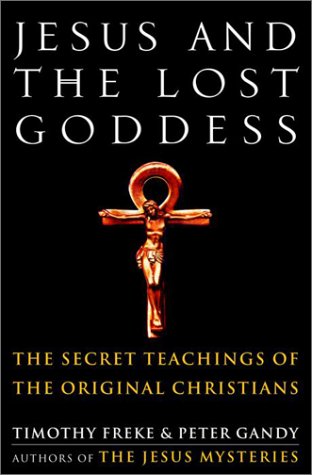
Why Were the Teachings of the Original Christians Brutally Suppressed by the Roman Church?
• Because they portray Jesus and Mary Magdalene as mythic figures based on the Pagan Godman and Goddess
• Because they show that the gospel story is a spiritual allegory encapsulating a profound philosophy that leads to mythical enlightenment
• Because they have the power to turn the world inside out and transform life into an exploration of consciousness
Drawing on modern scholarship, the authors of the international bestseller The Jesus Mysteries decode the secret teachings of the original Christians for the first time in almost two millennia and theorize about who the original Christians really were and what they actually taught. In addition, the book explores the many myths of Jesus and the Goddess and unlocks the lost secret teachings of Christian mysticism, which promise happiness and immortality to those who attain the state of Gnosis, or enlightenment. This daring and controversial book recovers the ancient wisdom of the original Christians and demonstrates its relevance to us today.
Last edited by freedom-man; 01-09-2014, 09:55 PM.Comment
-
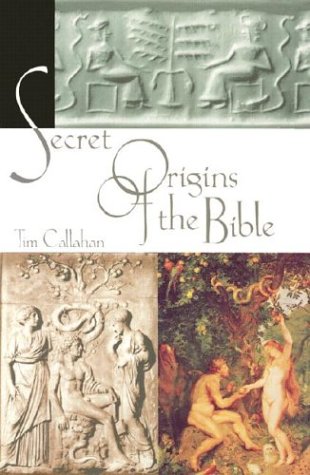
Clearly written and easily understandable by the lay reader.
• Thoroughly researched: author's points are backed by references in the writings of acknowledged scholars.
• Special features of the book: lavishly illustrated with multiple images in each illustration that show at a glance the mythic themes paralleling the bible.This book demonstrates that the stories and themes of the Bible were part of the great mythic systems of the ancient world by u sing comparative mythology, tell tale verses in the Bible and archaeology. The abstract God of modern monotheistic Judaism, Christianity and Islam is a comparatively recent creation. In later times the myth of a messianic deliverer was combined with that of the pagan god-man who suffered a horrible, excruciating death but was physically resurrected to produce the Christ myth.
Comment


Comment