You know there are families who dont buy their mothers gifts & things but give them the gift of time, energy and put on plays
The Founder Of Mother's Day Hated What The Holiday Became
The founder of Mother's Day wouldn't have wanted you to buy those flowers for mom. Or that card. Or those chocolates. In all likelihood, she wouldn't have wanted you to celebrate the holiday at all.
The fact that we will collectively spend nearly $20 billion on moms this year probably would have caused Anna Jarvis, the founder of Mother's Day, to throw her lunch on the floor like she reportedly did in the early 1900s, when she found out that a department store in Philadelphia was offering a Mother's Day special, according to Mental Floss.
Jarvis -- a West Virginia woman who didn't even have children of her own, according to History.com -- came up with the idea for a Mother's Day holiday, organizing the first celebration at a Methodist church in 1908. Annoyed that most American holidays were dedicated to honoring male achievements, Jarvis started a letter-writing campaign to make it a national holiday, involving wearing a white carnation, visiting your mother and maybe going to church.
Her campaign worked, but not in the way she hoped: She never wanted Mother's Day to be the commercial holiday it quickly came to be. (Although maybe she should have thought twice about getting financing for the first celebration from the owner of Wanamaker's, a major department store at the time.)
Soon after Congress made Mother's Day an official holiday in 1914, Jarvis was actively campaigning against it, leveling harsh criticism against florists, candy makers, greeting-card companies and anyone else looking to make a buck off the holiday.
A 1924 story published in the Miami Daily News and Metropolis detailed Jarvis's distaste for what Mother's Day had become. It pretty much comes down to this:
Consumerism stinks.
"Commercialization of Mother's Day is growing every year," says she. "Since the movement has spread to all parts of the world, many things have tried to attach themselves because of its success."
Florists are the worst.
"The red carnation has no connection with Mother's Day. Yet florists have spread the idea that it should be worn for mother who has passed away. This has boosted the sale of red carnations."
Candy makers are also the worst.
"Confectioners put a white ribbon on a box of candy and advance the price just because it's Mother's Day," she charges. "There is no connection between candy and this day. It is pure commercialization."
Greeting card makers are terrible (as are lazy kids who just send pre-written cards):
"The sending of a wire is not sufficient. Write a letter to your mother. No person is too busy to do this. Any mother would rather have a line of the worst scribble from her son or daughter than any fancy greeting card or telegram."
So there you have it. Straight from the founder of Mother's Day herself.
In honor of Mother's Day, which is today, we are repeating a previous answer about the history of the celebration and how the woman who started it didn’t approve of many traditions that arose surrounding it. Have a good day, moms out there.
Q. Who came up with the idea of Mother's Day?
S.V.
Answer. Anna Jarvis is generally recognized as the founder of a national day to recognize mothers.
Before Jarvis, there were other people in the United States who started celebrations honoring mothers in their towns. Mother's Day is celebrated in other countries, too.
Julia Ward Howe suggested a Mother's Day in 1872, and picked June 2 as the day. Howe was horrified by the carnage of the Civil War, and hoped that the idea of a day for mothers would promote peace. For several years, Howe held an annual Mother's Day observance in Boston. Mary Towles Sasseen, a Kentucky schoolteacher, started Mother's Day celebrations in 1887. Frank E. Hering of Indiana started a campaign for a national observance in 1904.
But Anna Jarvis gets most of the credit for establishing an official Mother's Day. Jarvis, of Grafton, W.Va., and Philadelphia, campaigned for a national Mother's Day in 1907. She chose the second Sunday in May and began the custom of wearing a white carnation. Jarvis was inspired by her own mother, a religious and community activist who encouraged people in her West Virginia community to provide relief to both Union and Confederate soldiers during the Civil War.
After her mother died, Jarvis began writing to political leaders, asking for their help in establishing an official day to honor mothers. In 1912, the General Conference of the Methodist Episcopal Church recognized Jarvis as the founder of Mother's Day. Governors in a few states proclaimed a Mother's Day in 1912 and 1913. In 1914, President Woodrow Wilson proclaimed Mother's Day as a national observance.
That's not the end of the story. Jarvis spent the rest of her days fighting against what she saw as the commercialization of Mother's Day.
The website www.about.com has more information about Jarvis and Mother's Day, and includes some of Jarvis' quotes complaining about customs that developed around Mother's Day, many of which continue to this day. In criticism of florists, she wrote, 'What will you do to route charlatans, bandits, pirates, racketeers, kidnappers and other termites that would undermine with their greed one of the finest, noblest and truest movements and celebrations?'
She didn't like the gifts or greeting cards or candy, either. 'A printed card means nothing except that you are too lazy to write to the woman who has done more for you than anyone in the world,' she remarked. 'And candy! You take a box to Mother — and then eat most of it yourself. A pretty sentiment.'
The selling of flowers got her goat, in particular, because she suggested the idea of people wearing a carnation on Mother's Day to honor their mothers. The police had to be called when Jarvis stormed a group's meeting to protest their sale of white flowers for Mother's Day. The group was the American War Mothers.
Jarvis never became a mother herself. She was confined to a nursing home for the last few years of her life, and died alone, at the age of 84. Forgiving florists paid her nursing-home bills.
The founder of Mother’s Day was a righteous, anti-capitalist *****. This year, let’s skip the toxic flowers and honor peace.
Now, I have nothing against a little shopping. We can’t all be DIY mavens. If my kids want a new pair of platform booties or if the maternal figures in my life desire hand-dipped chocolate, there’s going to be some barter or buying involved. But check it out: Each year now, Americans collectively spend nearly $20 billion on Mother’s Day.
It would be one thing if all that money bought some respect for the work all moms do—but so far, no luck. The spending spree, according to the National Retail Federation, is second only to Christmas and includes more than $2 billion spent on flowers, $1.5 billion on pampering gifts like spa treatments, and another $680 million on greeting cards. If you’ve seen some of the sickly sweet cards out there, I can probably interest you in a stylish designer barf bag made just for expectant moms.
For a holiday founded by anti-commercialization peace mamas, the current capitalist machine is beyond gag-worthy.
Celebrations of motherhood have been observed in lots of cultures and subcultures, but the U.S. version that’s gone global came out of women's peace groups. The idea was to honor moms who’d lost their sons to combat. Early activities included organized reconciliation meetings between mothers whose sons had fought or died on opposite sides of the Civil War. Think of that. Instead of toxic pedicures and Hallmark cards, these women exchanged tears and understanding for other mother’s grief.
Decades before Woodrow Wilson’s Mother’s Day Proclamation, women got together in "Mother's Day Work Clubs" not to brunch, but to address typhoid outbreaks by cleaning up both Union and Confederate encampments. In 1872, social justice activist Julia Ward Howe called for an celebration of "Mother's Day for Peace" that would be an anti-violence protest.
Anna Jarvis is known as the modern mother of Mother’s Day for her activism getting the official holiday on the books, envisioned “a day of sentiment, not profit.”
As you can imagine, it wasn’t long before she regretted her troubles. For one thing, she hated greetings cards. “And candy!” she protested, according to the book Women Who Made a Difference by Carole Crowe-Carraco. “You take a box to Mother—and then eat most of it yourself. A pretty sentiment.”
It wasn’t just candy companies that raised Jarvis’ hackles. In one press release criticizing the floral industry, Jarvis referred to those who profited from Mother’s Day as “charlatans, bandits, pirates, racketeers, kidnappers and termites that would undermine with their greed one of the finest, noblest and truest movements and celebrations.”
Beginning less than a decade after she’d won her fight to establish Mother’s Day, she took the other side. Jarvis, who didn’t have kids of her own, ended up spending all of her inheritance and the rest of her life fighting the abuse of the holiday. She organized boycotts and threatened lawsuits to try and curb the commercialization of it all. She crashed a candy-makers convention in Philadelphia in 1923, and then a gathering of the American War Mothers in 1925. This time she was arrested for disturbing the peace.
Anna Jarvis died the way too many righteous activists do—penniless in a sanitarium. This Mother’s Day, in honor of Anna Jarvis and other activists, make peace or disturb it as needed.
Here are eight ideas to get you started.
1. Honor Marginalized Mothers. The vast majority of images of mom you’ll see this Mother’s Day will picture the idealized American version: White, straight, married, mid-30s. But whites are a global minority—and we’d all like to see a little less of them. Queer parents of all genders cold use some positive words and imaging. Single and other unmarried moms need some brunch, too. Teen parents deserve to be idealized. Create and share images of and odes to the underrepresented mamas who've helped make your life better.
2. Get a Cooler Card. Not every greeting card creator is profiteering charlatan, of course. If you want to send mom or dad card and you don’t want to craft it yourself, pick a mama-made card like one from Katherine Arnoldi’s “Thanks, Mom” series. The proceeds go to help kids and families attending this year’s Allied Media Conference.
3. Turn Your Pain into Action. If you’re going to be spending mother’s day thinking about a mom you’ve lost or never known, take a cue from Anna Jarvis. Her own mother, Ann, was actually the one to start working for a "Mother's Friendship Day” in America. Daughter Anna only took up the fight after Ann died. So the founder of mother’s day was motherless, too. And many of those early peace activists had lost their sons to war. They didn’t have their children. They organized to help make their communities better. What’s an organization, individual, or nonprofit you can help support today?
4. Get active! Raise awareness about an issue that affects moms and kids. For example, you can honor the day by raising a ruckus for #BringBackOurGirls, the social media campaign focusing on the lack of media coverage on the kidnapping of 200 teen girls in Nigeria. Imagine busting your *** so your daughter can get an education, then getting news that she’s been kidnapped from her school. Adding insult to horror, your government officials shrug and tell you to keep quiet about the whole ordeal. Whether you’re the mother of one of the missing girls or not, don’t keep quiet. Call for international action to bring home the more-than 200 Nigerian students abducted from their dorm rooms last month, or another issue that you think is important.
5. Reclaim Fatherhood. Reclaim Fatherhood While You’re At It. How come the phrase "to mother a child" conjures ideas of nurturance while the phrase "to father a child" refers only to the act of knocking up your gal pal? Give props to the men in your life who want to nurture relationships and be held accountable. For anti-patriarchal community-building inspirations, pick up a copy of Rad Dad magazine.
6. Go Clean a Mother’s House. Even if you’re not in the middle of a typhoid outbreak in your community, you know your mama-friends could use a little clean-up help. Go and do a mom’s dishes, make dinner for a stressed out friend with kids, or offer to babysit so she can take a break.
7. Buy Fair-Trade Flowers. Like with the greeting cards, if you are going to buy flowers for your mom, get her ones that will actually make the world sweeter. If you want to pick up some flowers for the mom in your life, hit your local farmer’s market or fair-trade florist. Pesticide exposure contributes to high rates of miscarriage among pregnant flower industry workers and birth defects among their children. Moms, child laborers, and others reportedly work as much as 20 hours a day during the weeks before Valentine’s Day and Mother’s Day. All so we can show our love. As Anna Jarvis would say, “A pretty sentiment.”
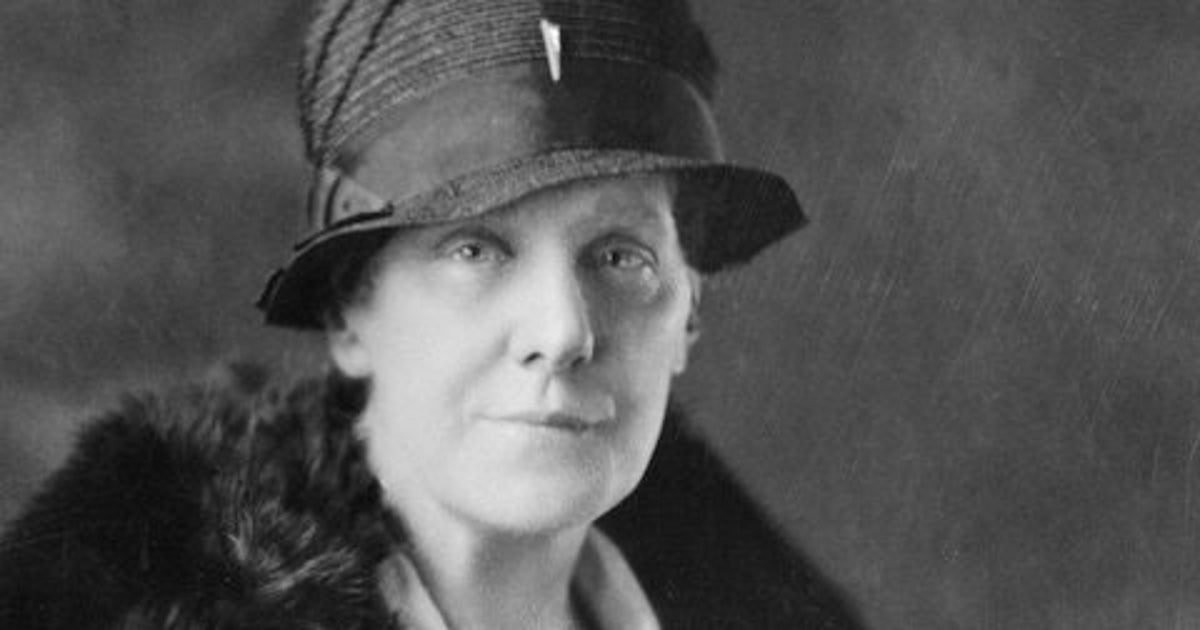
8. Wear a Cool Hat. Don’t have anyone—mother or otherwise—you want to engage with this Mother’s Day? I don’t blame you. I’m fed up with most people. Don’t worry, we can still be a part of Mother’s Day. I recommend picking up a little bit of Anna Jarvis' suave fashion sense. I’ll be rocking this hat:
Mother's Day creator likely 'spinning in her grave'
Pity the mother of Mother’s Day.
Pity the mother of Mother’s Day.
Anna Jarvis — never married, never a mother — campaigned for almost a decade to dedicate a day to honour mothers. She chose a Sunday because she wanted it to be a “holy” day, not a holiday, and the second Sunday in May because it was the anniversary of the death of her own beloved mother.
Jarvis wanted us to show our mothers how much their devotion and sacrifice matters, how we esteem the “truth, purity and broad charity of mother love.” She expected us to do it with simple gestures — in her opinion, a single white carnation and a heartfelt letter were best. Her carnations were handed out at the first Mother’s Day ceremony exactly 100 years ago.
And look at how we repaid her.
Throughout the decades, the “holy” day has evolved into a retailing and marketing bonanza, each year becoming more and more a chance to spend money rather than time or effort, until we arrive at today, when retailers can, with a straight face, suggest you “show Mom you care” by buying their platinum charm bracelet, their “Thanks A Bunch” floral arrangement, or their discounted patio furniture (nothing says filial love like a powder-coated aluminum table you scored for 50 per cent off).
“I wanted it to be a day of sentiment, not profit,” Jarvis complained, dismissing greeting cards as “a poor excuse for the letter you are too lazy to write.”
Anna Jarvis wasn’t too lazy to write letters. They were the greatest weapon in her campaign to create Mother’s Day.
According to Katharine Antolini, historian and board member at the International Mother’s Day Shrine in Grafton, West Virginia — site of the first ceremony in 1908 — legend has it that a 12-year-old Anna overheard her mother, Ann Reeves Jarvis, tell her Sunday school class of her wish for a day to commemorate mothers for their contribution to all fields of life. The elder Jarvis was well-known in Grafton for her charity work with local mothers and her efforts to use motherhood as a healing tool for the community divided by the Civil War.
When Ann Reeves Jarvis died in 1905, Anna began her campaign for a Mother’s Day, tirelessly writing letters to politicians, businessmen and religious leaders. She even enlisted the backing of retail giant John Wanamaker, who financially supported her campaign.
By 1908 she had succeeded in arranging two ceremonies for Mother’s Day: a large one in the auditorium of Wanamaker’s Philadelphia store, at which she spoke, and another one at her mother’s church in Grafton. She sent 500 white carnations to be distributed to mothers in the congregation.
The idea became a movement, and the following year, Mother’s Day services were held in 45 American states and Canada and Mexico, the symbol of the white carnation already entrenched.
Still, Jarvis wanted more: she wanted a national proclamation. She continued her lobbying, sending letters year after year to the governors of every state reminding them to make the proclamation.
Unusual for a middle-class woman at the turn of the last century, Jarvis had worked in the advertising department of a life insurance company and “she knew a thing or two about marketing and copyright,” says Antolini, who is writing her PhD dissertation on Anna Jarvis.
In 1912, Jarvis incorporated her own association, trademarked the white carnation and the phrases “second Sunday in May” and “Mother’s Day”. She was specific about the location of the apostrophe; it was to be a singular possessive, for each family to honour their mother, not a plural possessive commemorating all mothers in the world.
Finally, in 1914, U.S. President Woodrow Wilson issued a proclamation calling for the observance of Mother’s Day. Other countries followed, including Canada, which made it official the following year.
It was quickly apparent to Jarvis that she had created a monster. Greeting cards became a popular way to say thank you to Mother, photographers advertised Mother’s Day portraits and sales of chocolates and candies spiked every year in May.
You might think it would be enough to make her weep, but Anna Jarvis was made of sterner stuff. She threatened to sue.
“How many of these suits made it into court, we don’t know,” says Antolini. “But she was fearless. She would write letters to anyone she felt was misusing Mother’s Day and remind them that she owned the copyright.”
She nursed long-running feuds about who was the true founder of Mother’s Day, and was criticized for ignoring the work of poet Julia Ward Howe, who had instigated a Mother’s Day for Peace, observed in June, decades before Jarvis began her campaign. She would protest wherever she felt wronged, even in the store belonging to John Wanamaker, who had been so crucial to the success of her crusade.
An assistant told a story about going to the tea room at Wanamaker’s store one year at Mother’s Day. When Jarvis noticed a ‘Mother’s Day Salad’ on the menu, “she ordered it, dumped it on the floor, got up and left,” says Antolini.
In 1923, Jarvis threatened to sue New York Governor Al Smith over his plans for a large Mother’s Day celebration. She clashed with the American War Mothers Association over their use of Mother’s Day in their fundraising campaigns, so they dropped the apostrophe.
She even attacked Eleanor Roosevelt in 1935, accusing the First Lady of “crafty plotting” to abuse Mother’s Day by using it in fundraising material for charities trying to combat high maternal and infant mortality rates, “the expectant mother racket,” as Jarvis called them.
This is where her own mother would have disagreed with Anna Jarvis’s vision of Mother’s Day, says Antolini.
“Anna, who was never a mother, saw motherhood through the eyes of a child — she celebrated the reigning force in the household, the one who gave life and was the centre of your world as a kid.
“Her mother envisioned motherhood beyond the traditional sphere, and wanted it honoured for the way mothers improved the community.
“Anna had her vision, her mother had another, the florists and the politicians had another,” says Antolini. “Perhaps it’s so successful because it’s open to continual reinterpretation. I think that’s the beauty of it, although Anna is probably spinning in her grave at that thought.”
Indeed, Jarvis spent her considerable inheritance and the rest of her life fighting the commercialization of “her” holiday. It was a losing battle. Anna Jarvis died in 1948, bitter, blind, partially deaf and completely penniless in a Pennsylvania mental institution.
So on this Mother’s Day, 100 years after it all began, think of the Jarvis women. Think of Anna, and make a donation in your mother’s name to an organization that supports mothers in all their endeavours.
Or give Anna Jarvis what she fought so hard to create — a day with no shopping, no donations, no greeting cards. Sit down with a pen and a piece of paper, and write a love letter to your mother. Tell her what she means to you, what you love about her. Don’t fret if words aren’t really your thing — she already knows that, and will value the effort all the more.
If it’s too late — if the brunch is done and the shrink-wrap is already off the patio furniture — write the letter anyway.
Which do you think your mother will treasure for the rest of her days? It won’t be the patio furniture.
We process personal data about users of our site, through the use of cookies and other technologies, to deliver our services, personalize advertising, and to analyze site activity. We may share certain information about our users with our advertising and analytics partners. For additional details, refer to our Privacy Policy.
By clicking "I AGREE" below, you agree to our Privacy Policy and our personal data processing and cookie practices as described therein. You also acknowledge that this forum may be hosted outside your country and you consent to the collection, storage, and processing of your data in the country where this forum is hosted.


 Tweet
Tweet






Comment