

 Tweet
Tweet
mii kno jews neva played a bigg role inn da enslavement aff afrikkans inn merikka butt didd da jews played a bigg role inn da enslavement aff afrikkan inn jamaica?
-
-
Jews and plantation slavery in the Caribbean
Two Sundays ago, when I visited the Shaare Shalom synagogue for the Kingston on the Edge (KOTE) concert, 'Music Is Sacred', I got a grand tour of the Museum of Jamaican Jewish history that is located next door. My distinguished guide was Mr Ainsley Henriques, leader of the Jewish community in Jamaica.
The exhibits tell a captivating story of triumphant survival in exile. The display of sacred objects and cultural artefacts was supplemented by Ainsley's informative commentary. He's a historian and genealogist with a passion for heritage preservation. In fact, he's the current chairman of the board of trustees of the Jamaica National Heritage Trust.
I was somewhat surprised to see that the museum didn't tell the whole story of Jewish history in Jamaica. The role of Jews in plantation slavery is not documented at all. This silence is troubling, especially since so many students visit the museum each year. They end up getting a rather distorted account of Jamaican, not just Jewish, history.
In his prophetic song, Columbus, reggae philosopher Burning Spear warns that:
A whole heap a mix up, mix up
A whole heap a bend up, bend up
Go ha fi straighten out.
Burning Spear was, primarily, contesting the falsehood that Christopher Columbus 'discovered' Jamaica:
I an I all I know
I an I all I say
I an I reconsider
I an I an see upfully that
Christopher Columbus is a damn blasted
liar.
The reconsidering and 'upfull' revisioning that Burning Spear advocates can be applied as well to the many other partial histories we've inherited. Especially this year, as we celebrate 50 years of Independence, we must acknowledge Burning Spear's challenge to set the record straight.
Songs of lamentation
As it turns out, Jewish people played an undeniable role in plantation slavery in Jamaica. Ironically, Jewish exiles in the strange lands of the so-called 'New' World were complicit in the process of enslaving Africans. Forced to sing King Alpha's song, Africans in the diaspora found consolation in the sacred book of the Jews. They created their own dub version of Jewish songs of lamentation.
On that score, I got a rather stern response to last week's column, 'Rastafari reclaim Jewish roots', from Barbara Blake Hannah on Facebook: "'Reclaim' or 'share' Carolyn? 'Reclaim' would mean Rastafari originated from Judaism, not Christianity as I&I proclaim. And where were the Rastafari participating in the 'Nyabinghi'? Seems more like a Red Bones concert in the Synagogue with reggae Rasta artists! You mean to tell me that 'Selassie is God' was being chanted by those gathered? If so, sorry I missed the 'binghi'."
Of course, 'reclaim' does not imply a singular origin. The roots of Rastafari are rhizomatic, like ginger. And I was using binghi metaphorically. But, as I've learnt after almost three years of writing this column, some readers are quite suspicious of metaphors, preferring to take everything literally. Barbara insists on a 'correction'. So, to make her happy, I hereby renounce my use of the metaphor of the binghi. It was, literally, only a concert. And the roots of Rastafari really have nothing in common with ginger.
Movement of Jah people
How Jewish people came to be engaged in plantation slavery in the Caribbean is a rather long and complicated story. The Tribunal of the Holy Office of the Inquisition, more popularly known as the Spanish Inquisition, launched a holy war against non-Catholics in 1480. Jews and Muslims were the targets of attack. The tribunal was not abolished until 1834, the very same year that slavery was outlawed in the British Caribbean.
Muslims from North Africa, who were called Moors, had invaded the Iberian Peninsula in 711 and occupied it for almost 600 years. The Spanish Inquisition was a belated attempt to purify the land of 'foreign' religions. Many Jews supposedly converted to Christianity but practised Judaism in secret. The Alhambra decree, issued in January 1492, put an end to the pretence. It demanded the expulsion of Jews.
Columbus' 'discovery' opened doors of opportunity for Jews expelled from Spain and Portugal. Many Sephardic Jews went to Brazil where they made fortunes in plantation slavery. According to Ralph Bennett in an essay, 'History of Jews in Brazil', "It is believed that the first sugar cane was brought by a Jewish farmer from Madeira to Brazil in 1532. Sugar cane became the foundation of the Caribbean economy for several centuries."
At the end of the 15th century, the Pope had imperiously divided the 'New' World between the Spanish and the Portuguese. The grasp of the Inquisition reached Jews in Brazil. Many were again forced to convert to Catholicism. But in 1630, the Dutch West India Company captured the city of Recife in the north of Brazil and the religious freedoms enjoyed in Holland were extended to the colony. Jews could now openly practise their religion.
But freedom was short-lived. In 1645, the Portuguese launched war against the Dutch and reclaimed Recife in 1654, round about the same time that Jamaica became a British colony. Jews expelled from Brazil made their way to the Caribbean, first to Barbados and then Jamaica, taking with them the capital and technology of sugar production.
Historian Karl Watson notes that: "Barbados presented opportunities for trade. By the mid-17th century, it was quite apparent that the English experiment in creating colonies in the West Indies for the export of tropical crops was working exceptionally well in Barbados. These newcomers were well placed to exploit this burgeoning sugar economy as part of their extensive Sephardic trading network extending from the Atlantic to the Indian Ocean."
The Jewish exile in the Caribbean enabled the transatlantic trade in enslaved Africans and the migration of waves of indentured labourers from Europe and Asia. This is the other half of the Jamaican Jewish story that must be told. 'Jack Mandora, mi no choose none.'
Carolyn Cooper is a professor of literary and cultural studies at the University of the West Indies, Mona. Visit her bilingual blog at http://carolynjoycooper.wordpress.com/. Email feedback to [email protected] and [email protected].
-
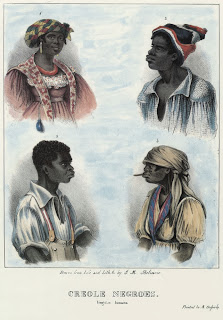
Happy (?) Jamaican Slaves via the Prints of Isaac Mendes Belisario
Isaac Mendes Belisario (1795-1849), has been described as the first documented Jamaican artist, but he was raised for a time in London, studied art and then worked as a stockbroker before returning Kingston, Jamaica, (a British colony) in the early 1830s. He became a well-known artist, painting landscapes and state portraits of important colonial residents, but he also made prints about the island’s local slave population. His work provides a rich description of Jamaican life at the time of the Emancipation, and while some of his observations seem one-sided according to today’s state of political correctness, they do enlighten us about slaves’ daily activities, and celebrations.
Belisario was a member of the Sephardic Jewish merchant class, who worked in retail, wholesaling, and dealt in the country’s slave trade. In 1831, Jamaica’s Assembly proclaimed the Jewish Emancipation Act, which allowed great freedoms for Jews versus the more restricted existence in London. One of Belisario’s distant relatives was briefly imprisoned by the Spanish Inquisition in 1656, before escaping to London. The other side of his family were in the opera and performed for the King of Spain. Another relative, Isaac’s uncle Jacob, was an art dealer, stockbroker and participant in a huge embezzlement scheme of the day.
Born in Kingston in 1794, Belisario was named after his grandfather, the Rabbi Isaac Mendes Belisario (1719-1791), of the Bevis Marks Synagogue in London. One of the Rabbi's sons, Abraham Mendes Belisario came to Jamaica in 1786 where he was employed by Alexandre Lindo, who was one of the wealthiest Jews on the island. Abraham married Alexandre's daughter, Esther, and he was made a partner in Lindo's business, When faced with bankruptcy, Isaac Mendes Belisario's father left his family in London, looked for a job and soon found himself in the West Indies, in Tortola, where he became the manager of seven sugar plantations. He was horrified to see how cruelly the slaves were treated and eventually served on a jury of the first white man brought up on murder charges for killing a slave in Tortola. He wrote an unsuccessful report calling for protection for the treatment of Africans in the West Indies. In addition, the artist’s maternal grandfather was involved in the finances of the Haitian revolution.
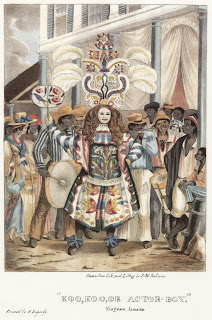
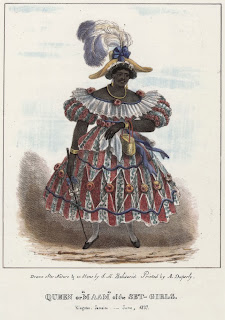
In 1837-38, Belisario made a series of hand-colored prints based on a holiday carnival practiced for decades by slaves, called " Sketches of Character In Illustration of the Habits, Occupation and Costume of the Negro Population in the Island of Jamaica " they were accompanied with detailed ethnographic texts. Although slavery was abolished in Jamaica in 1833, these prints were very telling about the perception of the lives of slaves, both before and after emancipation, and they are still very popular in Jamaica.
n tracing the West African roots of Jonkonnu and its evolution in Jamaica, it had its origins with Jon Konny, a celebrated Nzema chief who ruled over Prince's Town in the 17th and 18th centuries in what is now Ghana. The Jonkonnu masquerades became very elaborate, as they incorporated the traditions of other African peoples and even some European carnival traditions. If anything, Jonkonnu was a leveller of slave society where the great Jamaican houses were opened up to the slaves who "drank with their masters and spoke with greater familiarity"; the distance between them briefly forgotten.

All the images represent happy, smiling slaves, well-dressed in theatre European style costumes with fancy wigs and jewelry. He felt the power of these fascinating carnival scenes of slaves. Some of these parades and competitions borrowed from Shakespeare characters. In a blend of carnival and east African dance traditions, the "Jack-in-Green" image at the bottom of this article, we find a barefoot figure in the center of the image, where an initiate’s body is completely hidden by a mask on its face and long vegetable fibers cover the body. Black women in European costumes dance about the covered figure like moths to a flame. Belisario also includes in these images a masked dancer, John Canoe, who was a chief of the village in the Gulf of Guinea, working in the 1720s.
Isaac M. Belisario was not a well man; suffering from tuberculosis. He seems to have never married; nor had any children, although he still has collateral descendents in Jamaica and Australia. His last documented print was produced in 1846, and he is known to have died in London three years later. A book about this artist’s enthralling past has recently been published.
Comment
-
Dr. Tony Martin --- The Jewish Role in the African Slave Trade
Comment
-
this is once more one of those things... this is standard to the CXC sylabus... No serious history buys the discovery myth. We Tainos were in place along, along with Kalonggals and Ciboney.. in fact it is standard that Colons difference from welsh monks, irish monks, viking, english fishermen, phonecian, roman, nigerians was he set up colonies and began regular and documented communication.......Originally posted by blugiant View Post
Alls she wrote i learnt this in third form decades ago.....this is hardly hidden... Dutch jews were expelled from Brazil, the Dutch planters brought not the first cane but a different type of cane to Barbados....What she did not include that Columbus was partially finance by some conversos iews who were converted .. and all his ships was named after Gallego terms for street walkers....
So if u attended high school in Jamaica for the last three decades it is standard fare, hardly earth shattering....Comment
-
standard fe sum natt awl.Originally posted by Wahalla View Post
mii read a latt recentlee bout jewish presence ann influence inn jamaica ann sum aff da bizz dem tarted. even mattalon chattinn bout ting fe honor jewish cantreebutshans butt mii rarelee ear bout dem roles inn da enslavement aff afrikkan inn ja. woo were da bigg jewish plantation owners in jamaica? oww do dem role in slaveree impact jamaica tidday? do da spanish last names distort da histareeComment
-
standard information taught in the history syllabus for the English speaking Caribbean exam done at age 16-17......so mussi did never study history in Jamaica as a teenager.....Originally posted by blugiant View PostComment






Comment