

 Tweet
Tweet
Afro-Olmecs Came from the Mende Regions of West Africa
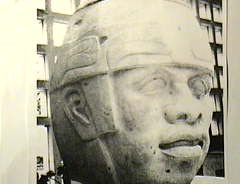
Although archeologists have used the name "Olmec," to refer to the Black builders of ancient Mexico's first civilizations, recent discoveries have proven that these Afro-Olmecs were West Africans of the Mende language and cultural group. Inscriptions found on ancient monuments in parts of Mexico show that the script used by the ancient Olmecs was identical to that used by the ancient and modern Mende-speaking peoples of West Africa. Racially, the collosal stone heads are identical in features to West Africans and the language deciphered on Olmec monuments is identical to the Mende language of West Africa, (see Clyde A. Winters) on the internet.
The term "Olmec" was first used by archeologists since the giant stone heads with the features of West African Negritic people were found in a part of Mexico with an abundance of rubber trees. The Maya word for rubber was "olli, and so the name "Olmec," was used to label the Africoid Negritic people represented in the faces of the stone heads and found on hundreds of terracotta figurines throughout the region.
Yet, due to the scientific work done by deciphers and linguists, it has been found out that the ancient Blacks of Mexico know as Olmecs, called themselves the Xi People (She People).
Apart from the giant stone heads of basalt, hundreds of terracotta figurines and heads of people of Negritic African racial reatures have also been found over the past hundred years in Mexico and other parts of Meso-America as well as the ancient Black-owned lands of the Southern U.S. (Wa****aw Proper,(Texas, Louisiana, Mississippi, Oklahoma, Arkansas), South America's Saint Agustin Culture in the nation of Colombia, Costa Rica, and other areas) the "Louisiana Purchase,"
lands, the south-eastern kingdom of the Black Jamassee, and other places including Haiti, see
the magazine Ancient American).
Various cultural clues and traces unique to Africa as well as the living descendants of prehistoric and ancient African migrants to the Americas continue to exist to this very day. The Wa****aw Nation of Louisiana is one such group (see www.Hotep.org), the Garifuna or Black Caribs of the Caribbean and Central America is another, the descendants of the Jamasse who live in Georgia and the surrounding states is another group. There are also others such as the Black Californian of Queen Calafia fame (the Black Amazon Queen mentioned in the book Journey to Esplandian, by Ordonez de Montalvo during the mid 1500's).
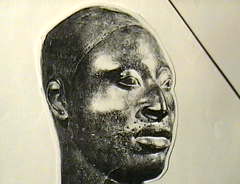
Cultural artefacts which connect the ancient Blacks of the Americas with Africa are many. Some of these similarities can be seen in the stone and terracotta works of the ancient Blacks of the Americas. For example, the African hairline is clearly visible in some stone and terracotta works, including the use of cornrows, afro hair style, flat "mohawk" style similar to the type used in Africa, dreadlocks, braided hair and even plain kinky hair. The African hairline is clearly visible on a fine stone head from Veracruz Mexico, carved between 600 B.C. to 400 B.C., the Classic Period of Olmec civilization. That particular statuette is about twelve inches tall and the distance from the head to the chin is about 17 centemeters. Another head of about 12 inches, not only posesses Negroid features, but the hair design is authentically West African and is on display at the National Museum of Mexico. This terracotta Africoid head also wears the common disk type ear plugs common in parts of Africa even today among tribes such as the Dinka and Shilluk.
One of the most impressive pieces of evidence which show a direct link between the Black Olmec or Xi People of Mexico and West Africans is the presence of scarification marks on some Olmec terracotta sculpture. These scarification marks clearly indicate a West African Mandinka (Mende) presence in prehistoric and ancient Meso-America. Ritual scarification is still practiced in parts of Africa and among the Black peoples of the South Pacific, however the Olmec scarification marks are not of South Pacific or Melanesian Black origins, since the patterns used on ancient Olmec sculpture is still common in parts of Africa. This style of scarification tatooing is still used by the Nuba and other Sudanese African people. In fact, the face of a young girl with keloid scarification on here face is identical to the very same keloid tatoos on the face of an ancient Olmec terracotta head from ancient Mexico. Similar keloid tattoos also appear on the arms of some Sudanese and are identical to similar keloid scars on the arms of some clay figures from ancient Olmec terracotta figurines of Negroid peoples of ancient Mexico.
Descendants of Ancient Africans in Recent America
In many parts of the Americas today, there are still people of African Negritic racial backgrounds who continue to exist either blended into the larger African-Americas population or are parts of separate, indigenous groups living on their own lands with their own unique culture and languages.
One such example is the Wa****aw Nation who owned about one million square miles of the former Louisiana Territories, (see www.Hotep.org), but who now own only about 70,000 acres of all their former territory. The regaining of their lands from the U.S. was a long process which concluded partially in 1991, when they won the right to their lands in a U.S. court.
The Black Californian broke up as a nation during the late 1800's after many years of war with the Spanish invaders of the South West, with Mexico and with the U.S. The blended into the Black population of California and their descendants still exist among the millions of Black Californians of today.
The Black Caribs or Garifunas of the Caribbean Islands and Central America fought with the English and Spanish from the late fifteen hundreds up to 1797, when the British sued for peace. The Garifuna were expelled from their islands but they prospered in Central America where hundreds of thousands live along the coasts today.
The Afro-Darienite is a significant group of pre-historic, pre-columbian Blacks who existed in South America and Central America. These Blacks were the Africans that the Spanish first saw during their exploration of the narrow strip of land between Columbia and Central America and who were described as "slaves of our lord" since the Spaniards and Europeans had the intention of enslaving all Blacks they found in the newly discovered lands.
The above mentioned Blacks of precolumbian origins are not Blacks wo mixed with the Mongoloid Indian population as occurred during the time of slavery. They were Blacks who were in some cases on their lands before the southward migrations of the Mongoloid Native Americans. In many cases, these Blacks had established civilizations in the Americas thousands of years ago.
An early Black Californian, a member of the original Black
aboriginal people of California and the South Western U.S.
THE USE OF ANCIENT AFRICAN SHIPS AND BOATS TO TRADE WITH THE AMERICAS
Protohistoric, prehistoric and ancient Negritic Africans were masters of the lands as well as the oceans. They were the first shipbuilders on earth and had to have used watercraft to cross from South East Asia to Australia about 60,000 years ago and from the West Africa/Sahara inland seas region to the Americas. The fact of the northern portion of Africa now known as a vast desert wasteland being a place of large lakes, rivers and fertile regions with the most ancient of civilizations is a fact that has been verified, (see African Presence in Early America, edt. Ivan Van Sertima and Runoko Rashidi, Transaction Publishers, New Bruinswick, NJ "The Principle of Polarity," by Wayne Chandler: 1994.)
From that region of Africa as well as East Africa, diffusions of Blacks towards the Americas as early as 30,000 B.C. are believed to have occurred based on findings in a region from Mexico to Brazil which show that American indians in the region include Negritic types (eg. Olmecs, Afro-Darienite, Black Californians, Chuarras, Garifunas and others). Much earlier journeys occurred by land sometime before 75,000 B.C. according to the Gladwin Thesis written by C.S. Gladwin. This migration occurred on the Pacific side of the Americas and was began by Africans with Affinities similar to the people of New Guinea, Tasmania, Solomon Islands and Australia. The earliest migrations of African Blacks through Asia then to the Americas seemed to have occurred exactly during the period that the Australian Aborigines and the proto-African ancestors of the Aborigines, Oceanic Negroids (Fijians, Solomon Islanders, Papua-New Guineans,and so on) and other Blacks spread throughout East Asia and the Pacific Islands about one hundred thousand years ago. The fact that these same Blacks are still among the world's seafaring cultures and still regard the sea as sacred and as a place of sustinence is evidence of their ancient dependance on the sea for travel and exploration as well as for commerce and trade. Therefore, they would have had to build sea-worthy ships and boats to take them across the vast expanses of ocean, including the Atlantic, Indian Ocean (both the Atlantic and Indian Oceans were called the Ethiopean Sea, in the Middle Ages) and the Pacific Ocean.
During the historic period close to the early bronze or copper using period of world history (6000 B.C. to 4000 B.C. migrations of Africans from the Mende regions of West Africa and the Sahara across the Atlantic to the Americas may have occurred. In fact, the Mende agricultural culture was well established in West Africa and the Sahara during that period. Boats still criss-crossed the Sahara, as they had been doing for over ten thousand years previously. The ancient peoples of the Sahara, as rock paintings clearly show, were using boats and may have sailed from West Africa and the Sahara to the Americas, including the Wa****aw territories of the Midwestern and Southern U.S. Moreover, it is believed by the aboriginal Black people of the former Wa****aw Empire who still live in the Southern U.S., that about 6000 B.C., there was a great population shift from the region of Africa and the Pacific ocean, which led to the migrations of their ancestors to the Americas to join the Blacks who had been there previously.
As for the use of ships, ancient Negritic peoples and the original Negroid peoples of the earth may have began using boats very early in human history. Moreover, whatever boats were used did not have to be sophisticated or of huge size. In fact, the small, seaworthy "outrigger" canoe may have been spread from East Africa to the Indian Ocean and the Pacific by the earliest African migrants to Asia and the Pacific regions. Boats of papyrus, skin, sewed plank, log and hollowed logs were used by ancient Africans on their trips to various parts of the world.
This stone belt was used by the Olmec ballplayers to catch the impact of the rubber balls in their ball games. This face is typical Negritic, including the eyes which seem to "slant," a common racial characteristic in West Africa, the Sahara and in South Africa among the Kong-San (Bushmen) and other Africans.
Although archeologists have used the name "Olmec," to refer to the Black builders of ancient Mexico's first civilizations, recent discoveries have proven that these Afro-Olmecs were West Africans of the Mende language and cultural group. Inscriptions found on ancient monuments in parts of Mexico show that the script used by the ancient Olmecs was identical to that used by the ancient and modern Mende-speaking peoples of West Africa. Racially, the collosal stone heads are identical in features to West Africans and the language deciphered on Olmec monuments is identical to the Mende language of West Africa, (see Clyde A. Winters) on the internet.
The term "Olmec" was first used by archeologists since the giant stone heads with the features of West African Negritic people were found in a part of Mexico with an abundance of rubber trees. The Maya word for rubber was "olli, and so the name "Olmec," was used to label the Africoid Negritic people represented in the faces of the stone heads and found on hundreds of terracotta figurines throughout the region.
Yet, due to the scientific work done by deciphers and linguists, it has been found out that the ancient Blacks of Mexico know as Olmecs, called themselves the Xi People (She People).
Apart from the giant stone heads of basalt, hundreds of terracotta figurines and heads of people of Negritic African racial reatures have also been found over the past hundred years in Mexico and other parts of Meso-America as well as the ancient Black-owned lands of the Southern U.S. (Wa****aw Proper,(Texas, Louisiana, Mississippi, Oklahoma, Arkansas), South America's Saint Agustin Culture in the nation of Colombia, Costa Rica, and other areas) the "Louisiana Purchase,"
lands, the south-eastern kingdom of the Black Jamassee, and other places including Haiti, see
the magazine Ancient American).
Various cultural clues and traces unique to Africa as well as the living descendants of prehistoric and ancient African migrants to the Americas continue to exist to this very day. The Wa****aw Nation of Louisiana is one such group (see www.Hotep.org), the Garifuna or Black Caribs of the Caribbean and Central America is another, the descendants of the Jamasse who live in Georgia and the surrounding states is another group. There are also others such as the Black Californian of Queen Calafia fame (the Black Amazon Queen mentioned in the book Journey to Esplandian, by Ordonez de Montalvo during the mid 1500's).
Cultural artefacts which connect the ancient Blacks of the Americas with Africa are many. Some of these similarities can be seen in the stone and terracotta works of the ancient Blacks of the Americas. For example, the African hairline is clearly visible in some stone and terracotta works, including the use of cornrows, afro hair style, flat "mohawk" style similar to the type used in Africa, dreadlocks, braided hair and even plain kinky hair. The African hairline is clearly visible on a fine stone head from Veracruz Mexico, carved between 600 B.C. to 400 B.C., the Classic Period of Olmec civilization. That particular statuette is about twelve inches tall and the distance from the head to the chin is about 17 centemeters. Another head of about 12 inches, not only posesses Negroid features, but the hair design is authentically West African and is on display at the National Museum of Mexico. This terracotta Africoid head also wears the common disk type ear plugs common in parts of Africa even today among tribes such as the Dinka and Shilluk.
One of the most impressive pieces of evidence which show a direct link between the Black Olmec or Xi People of Mexico and West Africans is the presence of scarification marks on some Olmec terracotta sculpture. These scarification marks clearly indicate a West African Mandinka (Mende) presence in prehistoric and ancient Meso-America. Ritual scarification is still practiced in parts of Africa and among the Black peoples of the South Pacific, however the Olmec scarification marks are not of South Pacific or Melanesian Black origins, since the patterns used on ancient Olmec sculpture is still common in parts of Africa. This style of scarification tatooing is still used by the Nuba and other Sudanese African people. In fact, the face of a young girl with keloid scarification on here face is identical to the very same keloid tatoos on the face of an ancient Olmec terracotta head from ancient Mexico. Similar keloid tattoos also appear on the arms of some Sudanese and are identical to similar keloid scars on the arms of some clay figures from ancient Olmec terracotta figurines of Negroid peoples of ancient Mexico.
Descendants of Ancient Africans in Recent America
In many parts of the Americas today, there are still people of African Negritic racial backgrounds who continue to exist either blended into the larger African-Americas population or are parts of separate, indigenous groups living on their own lands with their own unique culture and languages.
One such example is the Wa****aw Nation who owned about one million square miles of the former Louisiana Territories, (see www.Hotep.org), but who now own only about 70,000 acres of all their former territory. The regaining of their lands from the U.S. was a long process which concluded partially in 1991, when they won the right to their lands in a U.S. court.
The Black Californian broke up as a nation during the late 1800's after many years of war with the Spanish invaders of the South West, with Mexico and with the U.S. The blended into the Black population of California and their descendants still exist among the millions of Black Californians of today.
The Black Caribs or Garifunas of the Caribbean Islands and Central America fought with the English and Spanish from the late fifteen hundreds up to 1797, when the British sued for peace. The Garifuna were expelled from their islands but they prospered in Central America where hundreds of thousands live along the coasts today.
The Afro-Darienite is a significant group of pre-historic, pre-columbian Blacks who existed in South America and Central America. These Blacks were the Africans that the Spanish first saw during their exploration of the narrow strip of land between Columbia and Central America and who were described as "slaves of our lord" since the Spaniards and Europeans had the intention of enslaving all Blacks they found in the newly discovered lands.
The above mentioned Blacks of precolumbian origins are not Blacks wo mixed with the Mongoloid Indian population as occurred during the time of slavery. They were Blacks who were in some cases on their lands before the southward migrations of the Mongoloid Native Americans. In many cases, these Blacks had established civilizations in the Americas thousands of years ago.
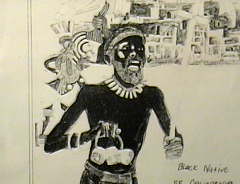
An early Black Californian, a member of the original Black
aboriginal people of California and the South Western U.S.
THE USE OF ANCIENT AFRICAN SHIPS AND BOATS TO TRADE WITH THE AMERICAS
Protohistoric, prehistoric and ancient Negritic Africans were masters of the lands as well as the oceans. They were the first shipbuilders on earth and had to have used watercraft to cross from South East Asia to Australia about 60,000 years ago and from the West Africa/Sahara inland seas region to the Americas. The fact of the northern portion of Africa now known as a vast desert wasteland being a place of large lakes, rivers and fertile regions with the most ancient of civilizations is a fact that has been verified, (see African Presence in Early America, edt. Ivan Van Sertima and Runoko Rashidi, Transaction Publishers, New Bruinswick, NJ "The Principle of Polarity," by Wayne Chandler: 1994.)
From that region of Africa as well as East Africa, diffusions of Blacks towards the Americas as early as 30,000 B.C. are believed to have occurred based on findings in a region from Mexico to Brazil which show that American indians in the region include Negritic types (eg. Olmecs, Afro-Darienite, Black Californians, Chuarras, Garifunas and others). Much earlier journeys occurred by land sometime before 75,000 B.C. according to the Gladwin Thesis written by C.S. Gladwin. This migration occurred on the Pacific side of the Americas and was began by Africans with Affinities similar to the people of New Guinea, Tasmania, Solomon Islands and Australia. The earliest migrations of African Blacks through Asia then to the Americas seemed to have occurred exactly during the period that the Australian Aborigines and the proto-African ancestors of the Aborigines, Oceanic Negroids (Fijians, Solomon Islanders, Papua-New Guineans,and so on) and other Blacks spread throughout East Asia and the Pacific Islands about one hundred thousand years ago. The fact that these same Blacks are still among the world's seafaring cultures and still regard the sea as sacred and as a place of sustinence is evidence of their ancient dependance on the sea for travel and exploration as well as for commerce and trade. Therefore, they would have had to build sea-worthy ships and boats to take them across the vast expanses of ocean, including the Atlantic, Indian Ocean (both the Atlantic and Indian Oceans were called the Ethiopean Sea, in the Middle Ages) and the Pacific Ocean.
During the historic period close to the early bronze or copper using period of world history (6000 B.C. to 4000 B.C. migrations of Africans from the Mende regions of West Africa and the Sahara across the Atlantic to the Americas may have occurred. In fact, the Mende agricultural culture was well established in West Africa and the Sahara during that period. Boats still criss-crossed the Sahara, as they had been doing for over ten thousand years previously. The ancient peoples of the Sahara, as rock paintings clearly show, were using boats and may have sailed from West Africa and the Sahara to the Americas, including the Wa****aw territories of the Midwestern and Southern U.S. Moreover, it is believed by the aboriginal Black people of the former Wa****aw Empire who still live in the Southern U.S., that about 6000 B.C., there was a great population shift from the region of Africa and the Pacific ocean, which led to the migrations of their ancestors to the Americas to join the Blacks who had been there previously.
As for the use of ships, ancient Negritic peoples and the original Negroid peoples of the earth may have began using boats very early in human history. Moreover, whatever boats were used did not have to be sophisticated or of huge size. In fact, the small, seaworthy "outrigger" canoe may have been spread from East Africa to the Indian Ocean and the Pacific by the earliest African migrants to Asia and the Pacific regions. Boats of papyrus, skin, sewed plank, log and hollowed logs were used by ancient Africans on their trips to various parts of the world.
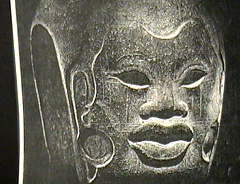
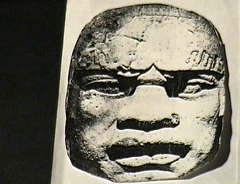
This stone belt was used by the Olmec ballplayers to catch the impact of the rubber balls in their ball games. This face is typical Negritic, including the eyes which seem to "slant," a common racial characteristic in West Africa, the Sahara and in South Africa among the Kong-San (Bushmen) and other Africans.





 sum aff dem bawl bout too much wukk butt sum aff dem defend mii cah dem yuths dramaicallee improved.
Comment